by Mahdi Sabbagh with Lorenzo Kom’boa Ervin
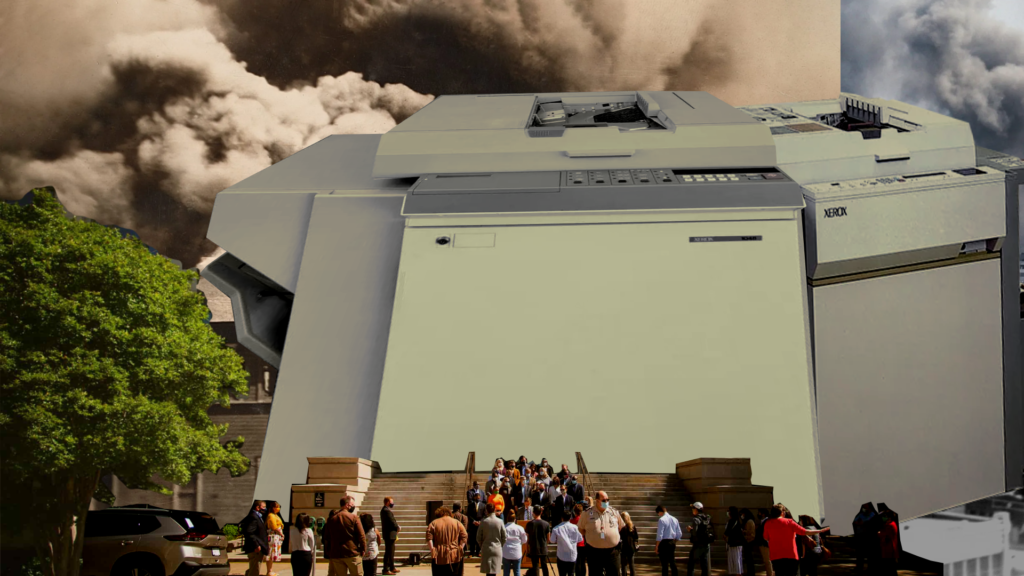
May 6, 2026—I begin my day reading about the “real estate expo” that took place at the Park East Synagogue on New York’s wealthy white Upper East Side neighborhood. My blood pressure spikes: this was a sale of stolen Palestinian land. My city allowed the sale to proceed, and the NYPD blockaded the entire neighborhood surrounding the synagogue to shield those who partook in the illegal land sale. Protesters were placed in sequestered pens away from the “real estate expo.” I find myself especially disgusted by the use of a place of worship to conduct land theft. The impunity with which those who have colonized my people’s land waltz around New York City, dancing on our graves, is maddening. In such moments, any semblance of belonging in this city away from home, and on this planet, dissipates. I no longer desire to live in this city, one that has normalized the besieging of entire districts, shutting down public space, and criminalizing speech for the benefit of genocide-supporters and land thieves, simply because they hold some political power. And yet, I also no longer feel the need to point fingers. The naked display of political power and violence speaks for itself.
The racism of zionists and white supremacists is systemic, and it fuels the expansion of the very same capitalist system, here and in Palestine. They are cogs in the machine. The protesters, and the mayor to a lesser extent, do what they can within this machine. What becomes clear to me is that by the time socialist, incremental, civil change arrives to me and my people, we will have long been exterminated. Sitting around and waiting to be recognized as human, waiting for this system to see the grave and ongoing injustice perpetrated by the zionist settler colony in Palestine, is a death sentence.
“I tell my students that hope sometimes looks like other things:
it looks like connection, like storytelling, like memory work.
It also looks like refusal.“
This is something that all Palestinians know very well. In our community space, where I teach a class on the architectural history of Palestine, I am asked where to find hope. I tell my students that hope sometimes looks like other things: it looks like connection, like storytelling, like memory work. It also looks like refusal. But it often feels like I am trying to convince myself as much as my students. This is the existential reality that Brother Lorenzo Kom’boa Ervin’s words pierced right through, reminding me that instead of searching for hope as a desperate reaction or remedy for settler cruelty, we ought to build hope from the ground up. In this piece, I try to convey how my time with Brother Lorenzo unsettled the hesitation, repression, self-hatred, and gaslighting that I, like all colonized people, struggle against daily.
The Miseducation of Lorenzo Kom’boa Ervin
Lorenzo Kom’boa Ervin, an elder of the Black radical tradition and the author of Anarchism and the Black Revolution, was once a young student. He studied Political Science at the University of Tennessee at Chattanooga and from there started an internship at City Hall. He had questions, and he wanted to understand the very system that deprived Black people of their political rights and resources. He was wondering about things like infrastructure and housing, and planning that ought to benefit their neighborhoods and cities.
At City Hall, Lorenzo quickly saw himself as a “secret spy.” He found evidence of ways in which institutions deemed public in fact facilitated the theft of resources from the Black community and diverted investment into rich people. Documentation revealed how federal funds allocated to the largest Black communities were being moved to rebuild downtown. Setting aside any doubt, fear, or personal gain, Lorenzo did what someone with a sense of moral responsibility would do: he began to copy file after file and liberate them by sharing them with the community. The files were fundamental in the education of an entire generation of activists. They provided evidence that the structure of City Hall, in which the processes of urban planning were unfolding, oppressed the Black community. Lorenzo’s files were circulated amongst activists and eventually made it to Black radio. Yes, this cost Lorenzo the ability to work in City Hall in the future, a negligible price to pay for what he built in return: relations with a community that provided him and countless other young Black people after him with another form of education. This was not a structure like a university or a government agency; it was a set of relations with activists who were fighting against structural racism, against the police state, as well as police killing and incarcerating Black people. They welcomed Lorenzo into a world of radical education. This was in the 1980s, towards the end of the Civil Rights Movement. Many people in the community had already developed a base political education that undid the white supremacist propaganda and the unquestioned quasi-worship of cops and of the military so central to American imperialist violence. Radical education required weekly or almost weekly meetings, where a continuity of thought and of discussions could flourish. The documents were discussed in those meetings. After all, community was the rightful home of government documents: if it ought to be for the people, then it belonged in the hands of the people.
With City Hall files in hand, the community filed a federal civil rights lawsuit, and the local government was forced to testify that in fact money “that was supposed to deal with poverty and with under-development in the Black community” was instead “going to the business sector downtown.” The spy’s liberated documents provided undeniable evidence, and the community won the lawsuit, forcing the structure of local government to change: the racists in power were made to step down, and “they never achieved government power again.”
While Lorenzo shared his memories with me, he followed up by reminding me that it wasn’t a revolution but merely an important protest movement that had unprecedented impact. As I listened to Lorenzo, I understood that this movement—in fact, all movements grounded in bottom-up formations of collective power—has the potential power to break apart structures of capitalist power. This was, of course, something not easily achieved. Building a movement required years upon years of work, of mending relations, of forming new ones, of learning and unlearning, of investing time and knowledge in community. And all while withstanding the regular blows—like clockwork—that come from structures of capitalist power that fundamentally cannot coexist with liberatory movements. Lorenzo explained that there were undercover cops, infiltrators, who were sent to spy on the community. This reminded me of the extensive network of spies hired or blackmailed by the zionist settler state to implant distrust and fear in the Palestinian community. Lorenzo appeared unsurprised: “It’s actually this thing of internal colonialism.” Of course. After all, Frantz Fanon reminds us that imperialism produces “tinctures of decay” that, when left untreated, continue to act as a “fertile purveyor for psychiatric hospitals.” All of us who have been colonized carry “the insult to mankind that exists in oneself.” What the Black radical tradition, as it developed in Chattanooga, understood was that the antidote to the possibility of infiltration was the very process of radical education that the movement had been building. Once strong enough, Lorenzo noted that it “couldn’t be stopped … even with the spies.”
“Out of movement building comes the idea of Black Radical Urbanism.
In this kind of urbanism, Lorenzo explained to me, the community isn’t simply
at the table of decision-making processes. Community is at the very center.“
Out of movement building comes the idea of Black Radical Urbanism. In this kind of urbanism, Lorenzo explained to me, the community isn’t simply at the table of decision-making processes. Community is at the very center.It is liberated, and urban planning comes into play only to rebuild the city for the community. It was not incremental change that was needed but a fundamental dismantling of oppressive structures before any kind of building could occur. This resonated with my disillusionment with institutional architectural education that centers a singular relation of power between a client (with surplus capital) and an architect (providing a service) and a construction worker (providing labor).
The 1996 Summer Olympics in Atlanta provoked one such project of Black radical urbanism. Lorenzo had been living there at the time and organized with the local community to fight the Olympics and the way in which it provided wealthy white people from the suburbs an opportunity to red-line and “take over the politics of the city.” Unsurprisingly, this naturally came with a plan to destroy entire Black neighborhoods. The community rose up and formed several movements, each tackling a specific facet of infrastructural disenfranchisement that the Olympics would usher in. One movement was the “Atlanta Transit Riders Union.” It fought a transit fare hike, a process through which white suburban elites who did not pay taxes in the city attempted to offset the cost of an extension in the transit system towards their suburbs by making the majority Black and working-class city of Atlanta pay, even though it would not benefit their community at all. The Atlanta Transit Riders Union took over the Metropolitan Atlanta Rapid Transit Authority (MARTA) system building in Atlanta and used it to conduct hearings and forced the administrators to sign an agreement that would prevent the fare hike. This was a process of reverse resource expropriation, of ensuring that more resources remained in the hands of the Black community.
In Black radical urbanism, relations and resources—what is essentially needed to rebuild the city—cannot flourish so long as there isn’t an expropriation of resources away from capitalist space and away from the many oppressive structures produced by “internal colonialism”: prisons, police stations, and so on. Once resources are expropriated and in the hands of the people, the movement will need “a battalion of grassroots organizers, with architects and others.” In Black radical urbanism, there is no singular relation of power. There are relations, overlapping, constantly mediating and working together. Architects are also liberated under this condition. No longer tasked with pleasing the rich client, they can work with and for their community, and practice architecture for its betterment. In such a city, Lorenzo explains, commercial spaces would not dominate the landscape. There would be no prisons, no police stations. People would build what they need: housing. In such a city, public space would be for the people; Black people would be celebrated and honored.
Designing Our Future
As I listened to Lorenzo, I began to dream and reflect on my besieged city, Occupied Jerusalem. As if through colonial mimetic inevitability, we, the daughters and sons of Jerusalem, through the dangerous act of existing as Palestinian, are also constantly embattled, trying to stop the expropriation of space by the settler state. Under an Israeli municipality that steals our land and demolishes our homes, we see public space as a threat to our communities. We understand that, fundamentally, the very idea of the public does not belong to all inhabitants of the city equally: some, in fact, do not belong there at all. We understand that anything designated as public—under the apartheid regime of white Jewish supremacy that is Israel—serves the Israeli public, especially its white first-class citizenry, and not those who either hold conditional citizenship or no citizenship at all. In Palestine at large, public space is the space of disciplining Palestinian bodies through strip-searches, humiliation, and death. Palestinians consequently vandalize public space as a form of protest against the structure of the state and its exclusionary construct of the “public.” In Palestinian movement building, especially in its nascent or early stages, it has been the interior space, the home, the club, the recreation center, where communities met in peace to mend relations, to organize, and to think together. Public space is where the inevitable battle for liberation would happen.
I know what this would look like. I have been imagining it my entire life: liberation materialized in my mind as I experienced the broken streets, overflowed sewage, episodic electricity and water cuts, and police harassment in our neighborhoods in Jerusalem. It was this very urban condition that propelled me into the world of urbanism and architecture in the first place.
A liberated Jerusalem would be a dismantling and reconfiguration of the political bodies and the entire economic logic of my city. It would look like the arrest and trial of the masterminds of structural inequality and land theft. It would look like the rewriting of city policies, regulations, and laws. It would look like the dismantling and trial of the Jerusalem police force. It would look like the expulsion of Ateret Cohanim, Elad, and other settler organizations.
It would look like the tearing down of the separation wall, barriers, and checkpoints that have tortured, maimed, and killed thousands. It would look like the dismantling of all settler roads, tunnels, bridges, and other pieces of segregated infrastructure that have disfigured our hills and valleys. It would look like seizing settler capital to build an urban rail line that connects Ramallah, Al Ram, Kufr Aqab, Jerusalem, and Bethlehem: no borders, only free flows.
It would look like the return of our refugees to their homes and lands. It would look like redistribution of wealth from settler to native, from West to East. It would look like reparations. It would look like the reappropriation and return of all stolen Palestinian property to their rightful owners: land, houses, artifacts, books, clothes, photographs. It would look like the barring of American, French, and British investors from buying property in Jerusalem and forcing them to pay damages to those they have displaced and priced out.
It would look like asking each Palestinian neighborhood what they wanted and then turning their demands into policy. It would look like more schools, more parks, more playgrounds. It would look like safe streets and safe children. It would look like the Muhammad Abu Khdeir Square, and Omar Hussam Yaqoub Shuwaiki Circle, and countless other sites waiting to be renamed by and for the people.
It would look like so much more. It would look like a list that continues to grow with the needs, wants, and dreams of Jerusalem’s Palestinians.