By Jessica Lynne with JoNina Abron-Ervin
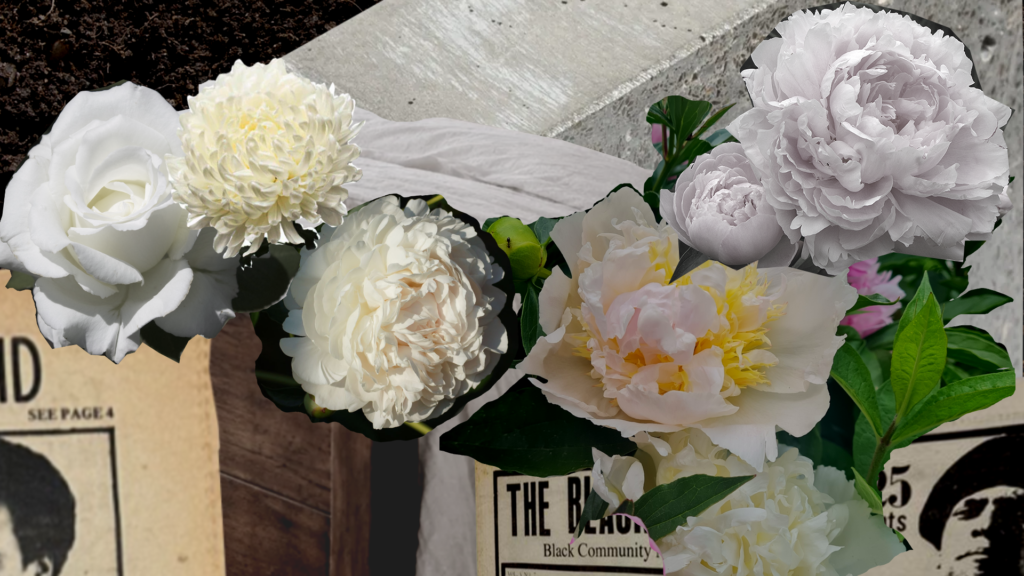
After my maternal grandmother died last August, I began to feel as though a cruel joke was being played on me and my family. Her death had come less than three months after the passing of her eldest daughter, my aunt, and my mother’s older sister. It was an occurrence as sad as it was uncanny—how do you prepare for even one person’s transition, let alone two, and so suddenly? As I traveled to gather with family last summer, I began to ask myself questions that I am sure are not unfamiliar to anyone who has experienced loss: what do I do with this grief? What rituals for remembrance do I take up?
Whatever shall I do with my dead asks the late poet Ntozake Shange in “for all my dead & loved ones.” I repeated that question often in the months that followed these deaths. Work continued, tasks were completed, countless emails were sent, and I rarely felt present for any of it. Instead, I thought about the rose bushes my grandmother used to keep in her front yard, dusty photo albums with the faces of relatives whose names I had not confirmed before her passing, and the raucous of a kitchen that would now be quieted forever. I thought about my aunt’s many plants that she kept in her apartment and how happy it would make me to take candid pictures of her and my mother whenever I was around them both at the same time. I felt a sense of exhaustion (that I know other family members felt as well), and I could not shake that feeling no matter how much I slept or procrastinated or talked about it with friends. And then, when my friend DéLana Dameron-John died three months after my grandmother, I reached a new low point. What to do with this catastrophe of loss?
“Part of my responsibility in the wake of profound transformation
is to keep on living. I closed 2025 with this final question on my mind:
what should my living look like now?“
In the last stanza of Shange’s poem, the speaker issues a gentle warning and declaration to any new person who enters into her life: if you wd have me speak/ you must learn the tongue of my dead & loved ones/ i have been left behind/a survivor/ holdin out for more. The speaker remains earthside to navigate the world now defined by a type of absence. She refers to herself as a survivor, as if death had been something arriving to her loved ones prematurely, unfairly. I could relate. At the same time, the speaker’s kin have also given her a language to take up as she keeps on living. She is waiting, possibly, to receive/experience/grasp onto something that evaded her beloveds. I take this to be the continuation of life in spite of the forces that assaulted her people. Shange reminded me that part of my responsibility in the wake of profound transformation is to keep on living. I closed 2025 with this final question on my mind: what should my living look like now?
Maybe you, reader, are like me in that you turn to models that have come before you to find answers to questions that trip you up. “You think your pain and your heartbreak are unprecedented in the history of the world, but then you read,” as James Baldwin once said. As an art critic, I’m inclined to initially reach for some art historical precedent as a source when faced with these types of dilemmas. It’s comforting, and I love the way I learn from artists. As a writer and editor, I tend to think about the form of whatever results from this reflection through the lens of my position as a media worker.
I was contemplating all of this when I spoke with JoNina Abron-Ervin one afternoon via Zoom in late spring, a little worried I was out of my depth in conversation with an elder whose lifetime of work is a case study in a principled editorial ethos. Ms. Ervin is widely regarded for her work as the final editor of The Black Panther Party newspaper, The Black Panther, after having been a member of the party, in addition to her time serving as the managing editor of The Black Scholar. She is as precise as she is wise, and our conversation traversed various subject matters: her mother’s creative writing and her own memoir writing; the Free Love era and the changing notions of partnership and marriage; the importance of intergenerational knowledge exchange. I could feel myself recharging.
The global conditions for Black living have rarely been easeful; I am convinced that this country has killed my people prematurely, even when indirectly. This is part of the heartache I have been feeling. We have witnessed a world completely remade in the six years that have gone by since the first wave of COVID-19’s devastation. A world undone by inefficient healthcare, war, material inequity, and genocide. In the U.S., the place from which I write, it is clear that many were not prepared for the collapse of a sociopolitical fantasy of this country’s excellence that has now so clearly given way to an authoritarian regime (even and perhaps especially when they elected the officials committed to this regime). The grief I navigated (and still navigate) on a personal level lives alongside the exasperation I hold for the ongoing violences of (inter)national policy and infrastructure failures.
So, when the sadness was especially new, still fresh as another Gregorian year arrived, I would grumble about my apartment, complain about the meaningless nature of writing and the “art world,” watch snowstorm after snowstorm blanket my town while winter dragged on. What was the point of it all? How could I transform this feeling that felt so large into something loving?
Months later, as I listened to Ms. Ervin assert her desire to better concern herself with her legacy as an elder who has been in the struggle for decades, it occurred to me that a legacy is akin to the shape of a life. If you are fortunate, you are given many years to refine and revise this shape. And perhaps, if you are among the fortunate, you are tasked with tending to the legacies of your dead and loved ones who were not recipients of this same abundance. Ms. Ervin has found the shape of a life that continues to blend her work as a writer and editor with radicalism and hope even as many people she loved did not make it. If you spend time with her book, Driven by the Movement: Reports from the Black Power Era, for example, you’ll see how she writes toward a liberatory horizon, and this action is what I also perceive Shange to have been ruminating on in her poem, too. What Ms, Ervin models for me is an example of a life that does not succumb to attempts of destruction. The point of it all? No one is meant to carry a sense of futility alone and certainly not in perpetuity.
“Exasperation, fatigue, and grief are coarse in their emotional textures,
but the beauty of surviving is that I know some joy can be found
within and through our struggle as well. Writing toward the promise of freedom
is the shape I want my living to maintain. It is possible, I keep telling myself.
I am not alone.“
Is such alchemy a straightforward process? Absolutely not, reader. I’m admitting that I forgot this truth for a moment. Exasperation, fatigue, and grief are coarse in their emotional textures, but the beauty of surviving is that I know some joy can be found within and through our struggle as well. Writing toward the promise of freedom is the shape I want my living to maintain. It is possible, I keep telling myself. I am not alone.
I am here, left behind, holding out for more, refusing the tyranny of AI slop, misinformation, and anti-intellectualism. When I ask what shape my living should take now, I am also affirming a commitment to responsibly steward information, media ecosystems, and pathways for storytelling so that I am able to not just tell the truth about my dead and loved ones but join a cipher of Black writers, poets, novelists, and journalists who refuse to metabolize the narrative fictions that white supremacy wants to feed us. This does not have to be a futile stance. There are those still with us from whom we can learn.